Portable AC vs Mini Split: Which Should You Buy?
Both portable ACs and mini splits cool your home without ductwork — but they’re very different products designed for very different situations. Choosing the wrong one could mean spending more money than necessary, or ending up with inadequate cooling.
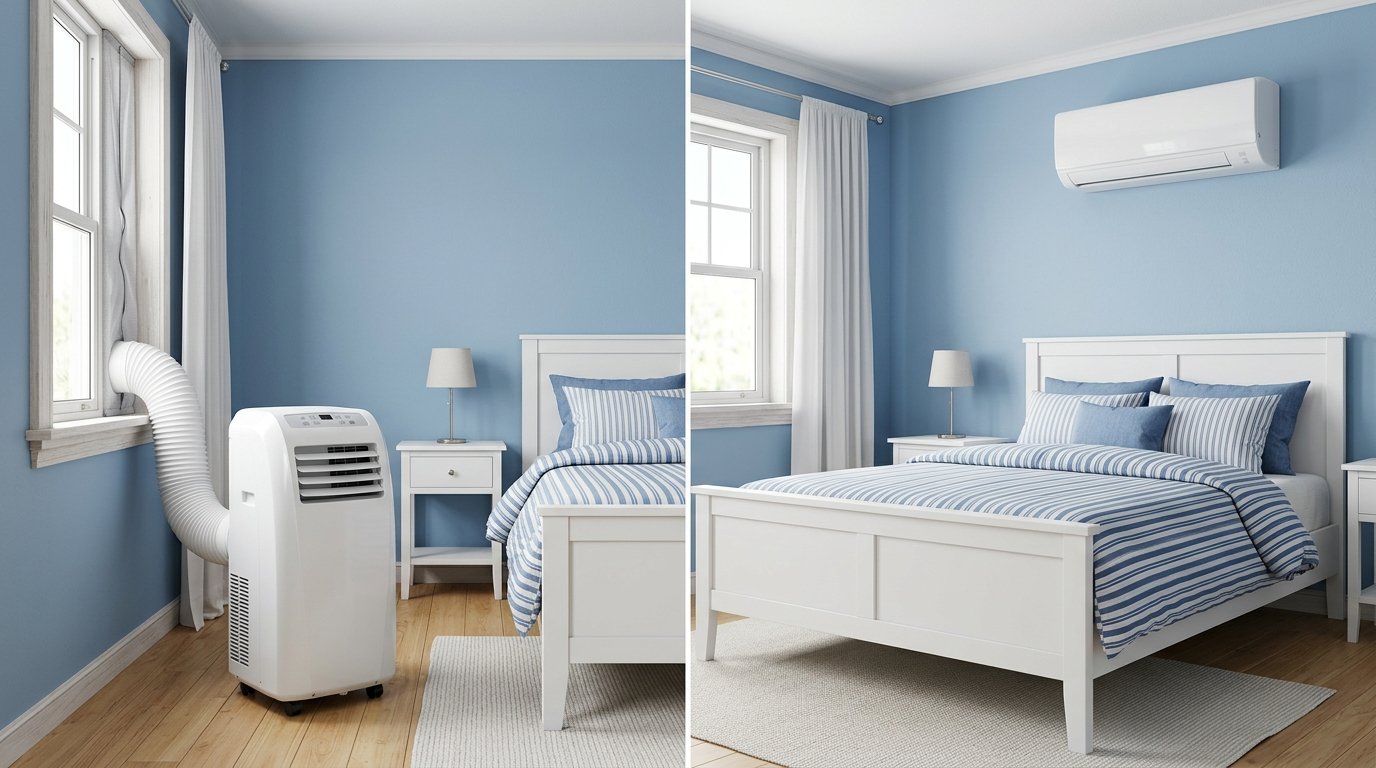
This guide breaks down every factor so you can make the right call for your home, budget, and lifestyle.
Quick Comparison
| Factor | Portable AC | Mini Split |
|---|---|---|
| Average cost | $200–$600 | $600–$2,000+ (installed) |
| Installation | Plug-and-go (minutes) | Professional install (hours) |
| Efficiency (SEER) | 8–12 | 18–33 |
| Cooling capacity | Up to 14,000 BTU | Up to 36,000+ BTU |
| Noise level | 50–60 dB | 19–40 dB |
| Portability | Move between rooms | Permanently mounted |
| Heats as well? | Some models | Yes (most models) |
| Rental-friendly | Yes | No (wall penetration) |
When a Portable AC Makes More Sense
A portable air conditioner is the right choice when one or more of these apply:
You Rent Your Home
Portable ACs require no modifications to walls, windows, or electrical systems beyond plugging in. You can take it with you when you move. Mini splits require drilling through walls and typically a dedicated electrical circuit — changes that most landlords won’t permit.
You Need Cooling in Multiple Rooms
Because portable ACs are on wheels, you can move them from the bedroom at night to your home office during the day. Mini splits are fixed in place. If your budget allows only one unit and you need flexibility, a portable AC wins.
Budget Is Your Primary Concern
A quality portable AC runs $250–$500. A comparable mini split — including professional installation — typically costs $1,200–$3,000. The upfront savings with a portable are significant, even if the long-term electricity costs are higher.
You Only Need Occasional Cooling
If you cool your home only a few weeks per year, the efficiency advantages of a mini split may never justify the higher cost. A portable AC that runs 30 days a year is a perfectly sensible solution.
When a Mini Split Makes More Sense
A mini split is the right choice in these situations:
You Own Your Home and Plan to Stay
The installation investment pays off over years of lower electricity bills. Mini splits operate at SEER 18–33, versus SEER 8–12 for most portable ACs. Over a full cooling season, that can translate to 40–60% lower energy costs.
You’re Cooling the Same Room All Season
If you have a specific room — master bedroom, living room, home addition — that needs reliable cooling every day from June through September, a mini split will handle it better. It cools faster, dehumidifies better, and maintains more precise temperature control.
You Want to Also Heat the Space
Most mini splits are heat pumps, meaning they heat and cool efficiently year-round. Portable ACs with heat modes exist, but they’re far less efficient for heating than a mini split heat pump.
Noise Matters to You
Mini split indoor units run at 19–32 dB — roughly the sound of rustling leaves. Portable ACs run at 50–60 dB, similar to a normal conversation. For bedrooms and home offices, this difference is significant.
You Want Higher Cooling Capacity
Portable ACs max out around 14,000 BTU, which covers rooms up to ~500 sq ft in normal conditions. Mini splits are available from 6,000 to 36,000+ BTU, capable of cooling large living rooms, open-plan areas, or even entire small homes.
The Efficiency Gap: How Much Does It Actually Cost?
Let’s run the numbers. Assume you’re cooling a 300 sq ft room 8 hours/day for 120 days/year, with electricity at $0.15/kWh.
Portable AC (10,000 BTU, SEER 10):
- Power draw: ~1,000 watts
- Annual cost: ~$144/year
Mini Split (12,000 BTU, SEER 22):
- Power draw: ~545 watts
- Annual cost: ~$79/year
Savings with mini split: ~$65/year
At that rate, the extra upfront cost of a mini split (~$1,000 more after installation) takes roughly 15 years to recoup in electricity savings alone. In hotter climates where you run AC for 6+ months, payback period shortens considerably.
The takeaway: for occasional use, the efficiency advantage doesn’t justify the cost. For heavy daily use, it does — especially over 10+ years.
Noise Comparison: What It Feels Like to Live With Each
Portable AC in a bedroom:
At 52–58 dB, you’ll hear it. Most people adapt within a few nights, but light sleepers often find it disruptive. Running it at the lowest fan speed reduces noise but also reduces cooling power.
Mini split in a bedroom:
At 19–26 dB on low, you may not notice it’s running. The outdoor unit makes more noise (40–55 dB), but if the compressor is on an exterior wall away from bedrooms, it’s rarely an issue.
Installation: What’s Actually Involved
Portable AC Installation
1. Unbox and place unit near a window
2. Install window exhaust kit (takes 10–20 minutes)
3. Connect the exhaust hose
4. Plug into a standard 115V outlet
5. Done — start cooling immediately
Mini Split Installation
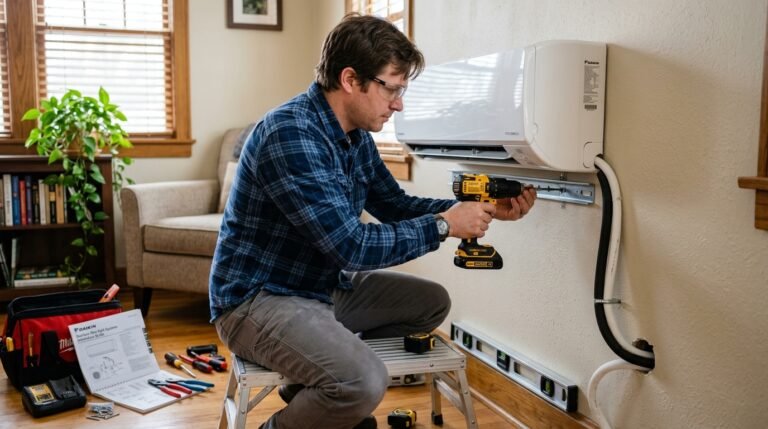
1. Mount indoor unit on wall
2. Drill 2.5–3 inch hole through wall for refrigerant lines
3. Run line set to outdoor location
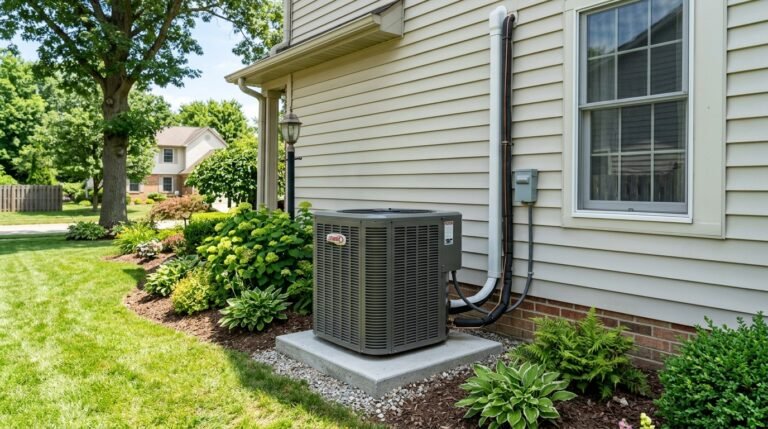
4. Mount outdoor unit on brackets or pad
5. Connect electrical (requires dedicated 240V circuit — electrician needed)
6. Charge and commission refrigerant lines (HVAC tech required unless DIY model)
7. Test and verify operation
For DIY models like the MRCOOL DIY, steps 6 is simplified. But even so, budget 4–8 hours and having another person to help.
Our Recommendation
Choose a portable AC if:
- You rent
- You need one unit to cool multiple rooms
- Your budget is under $500
- You only need cooling occasionally
Choose a mini split if:
- You own your home
- You’re cooling the same room every day
- Long-term energy savings matter to you
- You want to heat the space in winter too
- Noise level is important
For most homeowners with a dedicated room to cool, a mini split is the better long-term investment. For renters and those needing flexibility, a portable AC is the practical choice.
Our Top Picks in Each Category
Best Portable AC: Whynter ARC-14S (14,000 BTU, dual hose)

Best DIY Mini Split: MRCOOL DIY 12,000 BTU

Best Value Mini Split: Pioneer WYS012GMFI19RL

Need help finding the right BTU? Use our BTU Calculator.
Frequently Asked Questions
Is a mini split worth it over a portable AC?
For homeowners using AC daily through a full season, yes. The lower energy bills and better performance justify the higher upfront cost. For renters or occasional use, a portable AC is more practical.
Can a portable AC cool as well as a mini split?
Not at the same efficiency. A portable AC must work harder (and use more electricity) to achieve the same cooling because it draws air from inside the room rather than exclusively from outside.
Do portable ACs need to be emptied?
It depends on the model and humidity levels. Self-evaporating models (like the Whynter ARC-14S) rarely need manual draining. In very humid climates, even self-evaporating units may need occasional emptying.
Can I install a mini split myself?
With DIY-specific models like the MRCOOL DIY, yes. Traditional mini splits require a licensed HVAC technician for refrigerant handling. You’ll also need a licensed electrician for the dedicated 240V circuit on any model.
Which is better for a garage?
A mini split is generally better for a garage — it handles the larger space, higher temperatures, and can be permanently installed without occupying floor space. If it’s a rental space or you need temporary cooling, a portable AC works fine.
Last updated: May 2026. Prices may vary. As an Amazon Associate, we earn from qualifying purchases.
For a deeper look at the efficiency numbers, the EPA’s guide to energy-efficient cooling explains how SEER2 and SACC ratings are calculated and what they mean for your electricity bill.
The DOE’s energy savings tips for cooling recommend combining any AC system with proper insulation and air sealing to maximize comfort and minimize energy costs.
Frequently Asked Questions
Is a mini split better than a portable AC?
For permanent use, a mini split is significantly better — more efficient, quieter, more powerful, and it heats too. A portable AC wins on flexibility since it requires no installation and can be moved between rooms.
How much more efficient is a mini split than a portable AC?
Mini splits are typically 30–50% more efficient than portable ACs. A mini split at 20 SEER2 vs a portable at 10–12 SACC uses roughly half the electricity for the same cooling output.
When does it make sense to choose a portable AC over a mini split?
Choose a portable AC if: you rent and can’t make modifications, you need cooling in multiple rooms, you only need AC a few weeks per year, or your budget is under $500.
Can a portable AC replace a mini split?
For occasional or short-term use, yes. For primary climate control in a room you use daily, a mini split is the better long-term investment — the efficiency savings typically pay back the price difference within 3–5 years.
What is the main disadvantage of a portable AC?
The main disadvantage is efficiency loss from single-hose designs that create negative pressure in the room, pulling warm air in from gaps around doors and windows. Dual-hose models reduce this problem significantly.